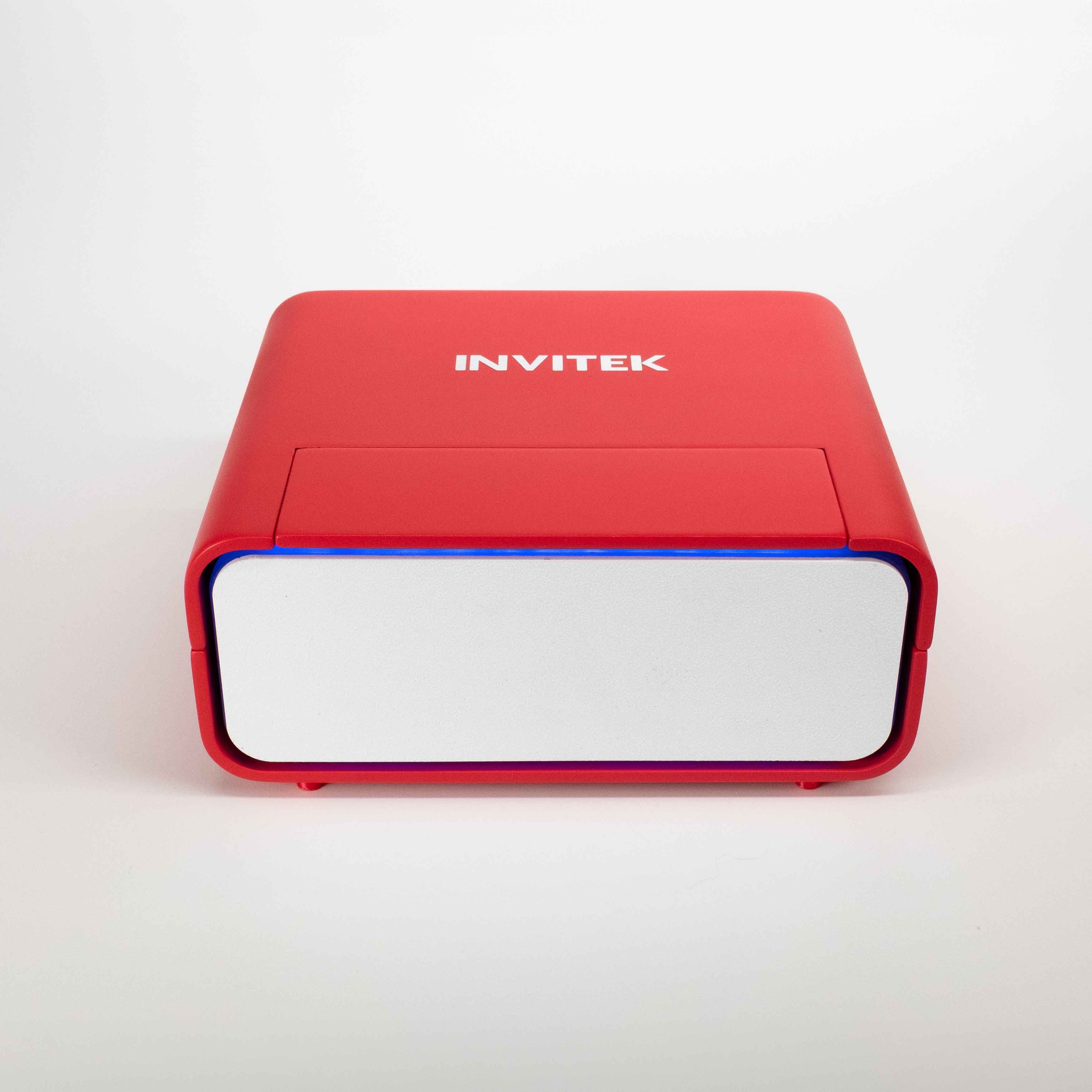
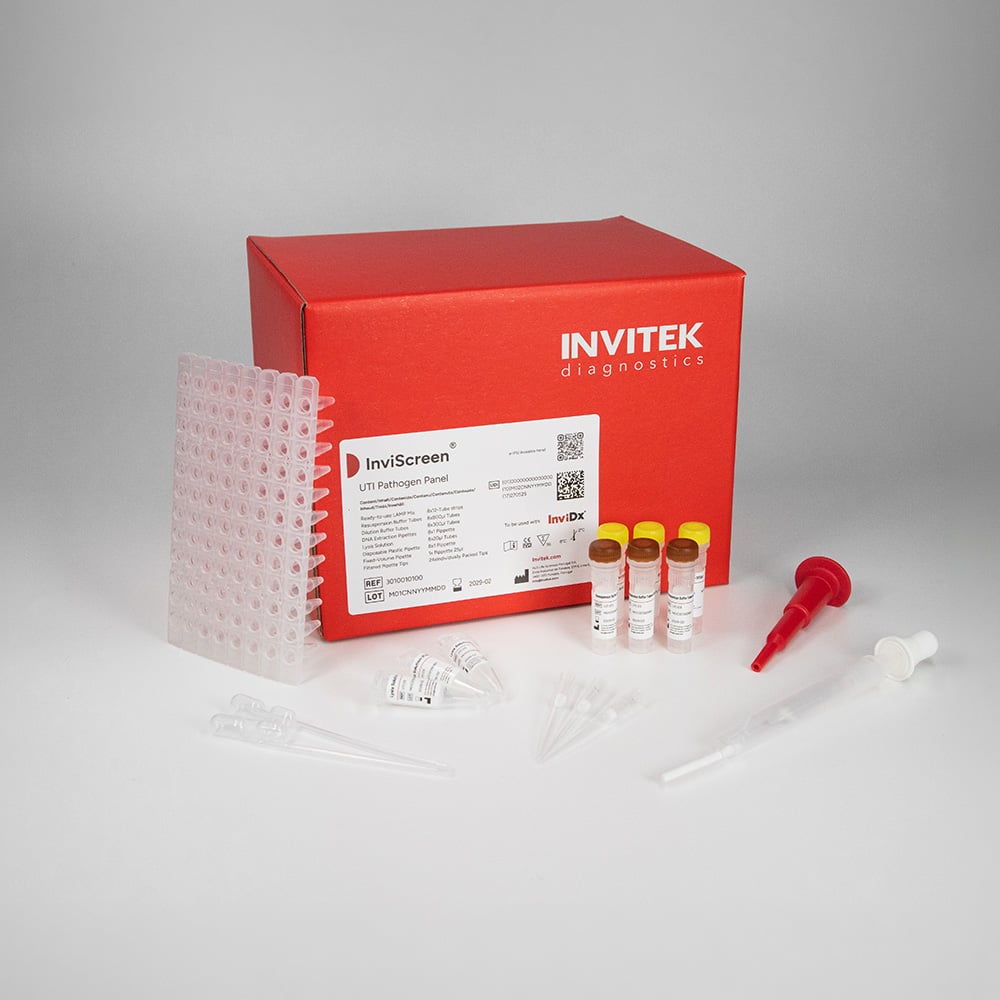
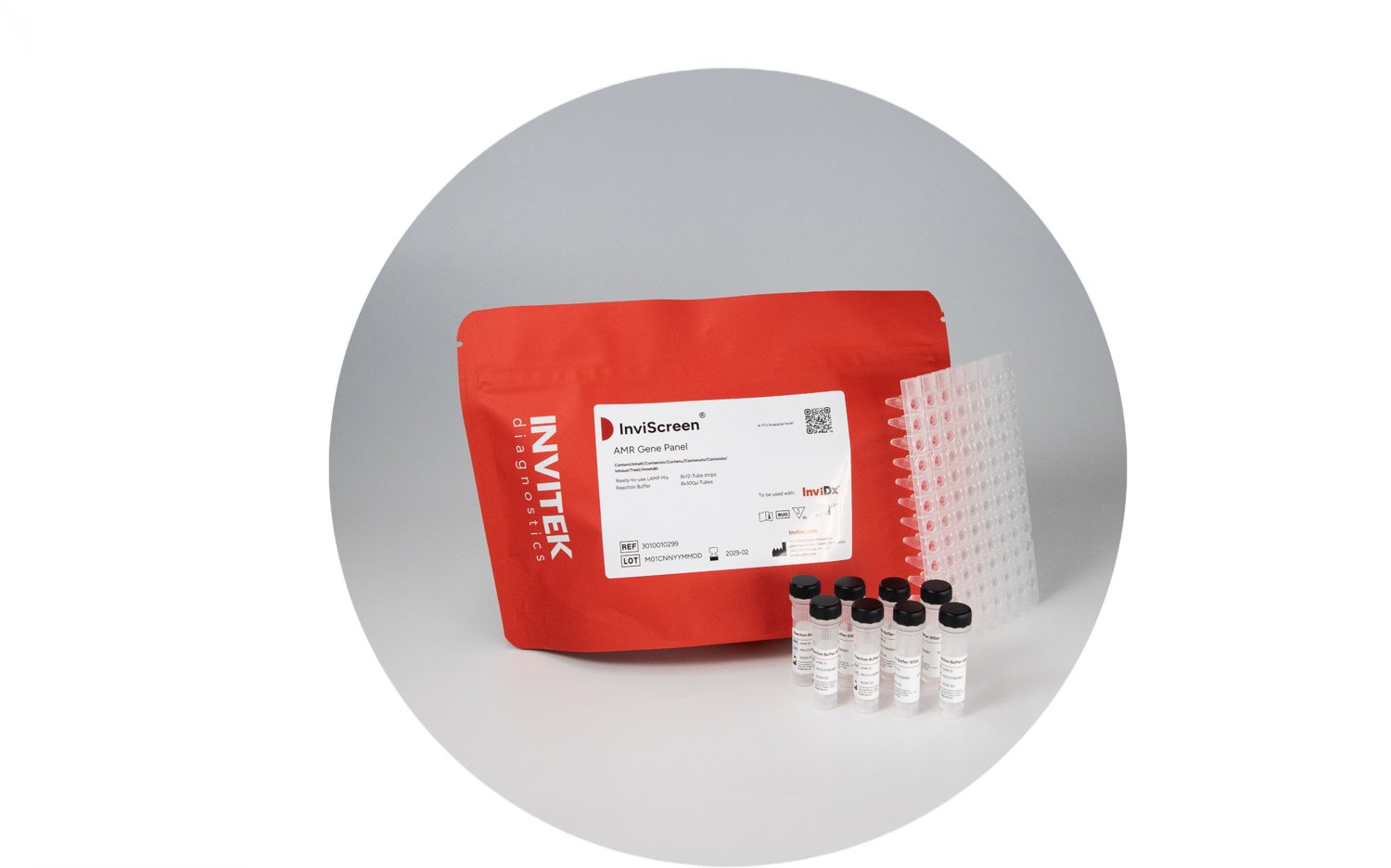
InviScreen® AMR Gene Panel
Item No.: 3010010299
Highlights:
- Rapid detection of selected antimicrobial resistance-associated gene target groups
- Qualitative LAMP-based detection in only 45 minutes on the InviDx® instrument
- Automated data analysis and result interpretation via the InviDx® Hub
- Designed for research and One Health surveillance using purified DNA from human, animal, food and environmental sample sources, as well as microbial isolates
Product Details
The InviScreen® AMR Gene Panel is a qualitative molecular research assay for the detection of selected antimicrobial resistance-associated gene targets in purified DNA. Using Loop-mediated Isothermal Amplification (LAMP) on the InviDx® System, the assay supports rapid AMR research and surveillance across human, animal, food and environmental One Health settings.
The InviScreen® AMR Gene Panel detects the following AMR gene classes and targets:
- dfrA (trimethoprim resistance)
- fosA (fosfomycin resistance)
- SHV / TEM (extended-spectrum β-lactamase and β-lactamase variants)
- CTX-M (extended-spectrum β-lactamase variants)
- Class A / Class D carbapenemases (serine carbapenemases)
- qnrB (plasmid-mediated quinolone resistance)
- vanA (vancomycin resistance)
- mecA (methicillin resistance)
- MBL (metallo-β-lactamases; e.g., NDM, VIM, IMP families)
- mcr (colistin/plasmid-mediated polymyxin resistance)
By detecting these AMR gene classes, the InviScreen® AMR Gene Panel provides broad coverage of approximately 200 resistance-gene variants across human, veterinary, food and environmental settings.
The kit can be used in combination with the InviScreen® UTI Pathogen Panel to identify AMR genes in pathogens associated with urinary tract infections (UTI) in urine samples. DNA isolates of other human, animal or environmental sample types may be analysed in the context of One Health surveillance. Learn more about One Health surveillance.
The assay workflow is designed for near-sample and decentralized molecular testing environments. Positive and negative controls are included to monitor assay validity and help identify potential run failures.
For Research Use Only (RUO). Intended for use by trained personnel.
Product specifications
| Specifications | |
|---|---|
| Contents | 8 x 12-well reaction strips containing lyophilized reaction mixes |
| Specimen type | DNA isolates of various sample types |
| Sample Preparation | DNA must be extracted using a method appropriate for the respective source matrix. A total of 25-75 µL purified DNA is required per sample. For urine-derived DNA, the extraction workflow provided with the InviScreen® UTI Pathogen Panel may be used where appropriate. Users should verify the suitability of alternative sample-preparation workflows for their intended research application. |
| Panel targets |
dfrA12, dfrA14, dfrA17, fosA5, fosA6, blaTEM, blaSHV, blaCTX-M-1, blaCTX-M-2, blaCTX-M-9, blaKPC, blaGES, blaOXA-48, qnrB1, qnrB3, qnrB5, qnrB6, vanA, mecA, blaVIM, blaNDM, blaIMP-22, mcr-1, mcr-9, mcr-10
|
| Internal controls | Included |
| Turnaround time | 45 min |
| No. of tests | 8 |
| Technology | Isothermal amplification (LAMP) |
| Instrument compatibility | InviDx® Instrument |
| Certification | RUO |
Resources

Instructions for Use InviScreen® AMR Gene Panel
Ordering Details
| Product Name | Package Size | Catalogue No. |
|---|---|---|
| InviScreen® AMR Gene Panel | 8 samples | 3010010299 |
FAQs
-
1. What is the InviScreen® AMR Gene Panel?
The InviScreen® AMR Gene Panel is a molecular assay for the qualitative detection of clinically relevant antimicrobial resistance (AMR) genes in DNA isolated from various sample types. The assay is designed for use with the InviDx® instrument and supports rapid, decentralized AMR screening.
-
2. Which antimicrobial resistance genes does the panel detect?
The InviScreen® AMR Gene Panel detects clinically relevant target genes from the following AMR groups:
ANTIBIOTIC CLASS AMR GROUP TARGET GENE(S) Trimethoprim / antifolates dfrA (trimethoprim resistance) dfrA12, dfrA14, dfrA17 Fosfomycin fosA (fosfomycin resistance) fosA5, fosA6 β-lactams TEM/SHV β-lactamases; some variants are extended-spectrum β-lactamases (ESBLs) blaTEM, blaSHV Extended-spectrum β-lactams CTX-M ESBL groups blaCTX-M-1, blaCTX-M-2, blaCTX-M-9 Carbapenems and other β-lactams Class A and Class D serine carbapenemases blaKPC, blaGES, blaOXA-48 Fluoroquinolones qnrB (plasmid-mediated quinolone resistance) qnrB1, qnrB3, qnrB5, qnrB6 Glycopeptides vanA (vancomycin resistance) vanA β-lactams: anti-staphylococcal penicillins and cephalosporins mecA (methicillin resistance) mecA Carbapenems and other β-lactams MBL (Class B metallo-β-lactamases) blaVIM, blaNDM, blaIMP-22 Polymyxins mcr (mobile/plasmid-mediated colistin resistance) mcr-1, mcr-9, mcr-10 By detecting these AMR targets, the InviScreen® AMR Gene Panel provides broad coverage of approximately 200 resistance-gene variants carrying these resistance genes.
-
3. What technology does the InviScreen® AMR Gene Panel use?
The assay uses qualitative Loop-mediated Isothermal Amplification (LAMP) to detect the AMR gene targets. LAMP is an isothermal nucleic acid amplification technology. Amplification is performed on the compatible InviDx® instrument.
-
4. How quickly are results available?
The assay provides AMR gene detection in approximately 45 minutes on the InviDx® instrument. Following amplification, results are automatically interpreted using the InviDx® Hub.
-
5. What is the InviDx® Hub?
The InviDx® Hub is the software platform used for automated result interpretation.
It applies AI-based, assay-specific analysis to data generated by the InviDx® instrument and supports standardized result reporting.
-
6. Which instrument is required to run the assay?
The InviScreen® AMR Gene Panel is designed for use with the InviDx® instrument. Result interpretation is performed using the associated InviDx® Hub.
-
7. Can the AMR Gene Panel be used together with the InviScreen® UTI Pathogen Panel?
Yes. The InviScreen® AMR Gene Panel can be used in combination with the InviScreen® UTI Pathogen Panel. The InviScreen® UTI Pathogen Panel includes a dedicated sample extraction workflow. The DNA extracted during this workflow can subsequently be tested with both the InviScreen® UTI Pathogen Panel and the InviScreen® AMR Gene Panel.
Using both panels can support the detection of urinary tract infection-associated pathogens and selected antimicrobial resistance genes from the same extracted DNA sample. The two panels are separately available products.
-
8. Does the AMR Gene Panel identify the pathogen causing an infection?
The InviScreen® AMR Gene Panel detects selected antimicrobial resistance gene targets. It is not designed to identify specific pathogens.
For urinary tract infection testing, the AMR Gene Panel can be used together with the InviScreen® UTI Pathogen Panel, which detects UTI-associated pathogens.
-
9. Which sample types can be tested with the InviScreen® AMR Gene Panel kit?
The kit is designed for the analysis of any previously isolated DNA in liquid format. DNA from various human, animal or environmental sample types can be analysed, supporting a broad range of One Health surveillance applications.
For each AMR detection run of 12 reactions (10x AMR gene targets, 1x positive control and 1x negative control) only 25 µl of DNA solution are required.
-
10. Is the assay suitable for near-sample or decentralized testing?
Yes. The InviScreen® AMR Gene Panel is designed for near-sample and decentralized molecular testing environments using the InviDx® instrument.
Its rapid workflow and reagent format support flexible use outside centralized laboratory settings, including human health, veterinary and environmental surveillance applications. .
-
11. Can the assay be used for One Health surveillance?
Yes. The InviScreen® AMR Gene Panel can support One Health surveillance across human, animal and environmental settings.
The assay enables the detection of selected AMR gene targets together covering approximately 200 resistance-gene variants [OH5.1]in DNA isolations from various sample types.
Learn more about One Health surveillance.
-
12. Are positive and negative controls included?
Yes. Positive and negative controls are included in the assay. The controls help monitor assay validity and identify potential run failures.
-
13. Does the assay detect antimicrobial resistance itself?
The assay detects selected genes associated with antimicrobial resistance. A detected AMR gene may be associated with resistance to a specific antimicrobial class. However, results should be interpreted together with the relevant organism, clinical or surveillance context and other laboratory findings.
-
14. Does a negative result rule out antimicrobial resistance?
No. A negative result means that the AMR gene targets included in the panel were not detected. A negative result does not exclude resistance caused by other genes, mutations, resistance mechanisms or targets that are not included in the panel.
-
15. Does a positive result confirm phenotypic resistance?
No. The assay detects the presence of selected AMR gene targets and does not directly measure phenotypic antimicrobial susceptibility. Additional laboratory testing may be required to characterize antimicrobial susceptibility or confirm the clinical significance of a result.
-
16. Is the InviScreen® AMR Gene Panel intended for clinical diagnostic use?
The InviScreen® AMR Gene Panel is for Research Use Only (RUO).
The assay is intended for use by trained personnel. It is not intended for human diagnostic procedures.